Multi-Covariate Randomization
For more advanced preclinical study designs, it's often necessary to balance experimental animal groups across multiple covariates simultaneously to minimize confounding factors and enhance statistical power. Consider an experimental setup involving three key covariates:
- The size of the left tumor;
- The size of the right tumor;
- The blood pressure.
 +
+
As the number of covariates increases, the complexity of achieving optimal group balance grows exponentially, making traditional randomization methods insufficient.
While simple randomization (random assignment) is suboptimal for such complex, low-sample-size experiments, Randmice can easily handle this challenge. Our platform systematically tests multiple combinations to find the optimal balance across all specified covariates, ensuring robust and reliable experimental outcomes.
Comparative Analysis of Multi-Covariate Balancing
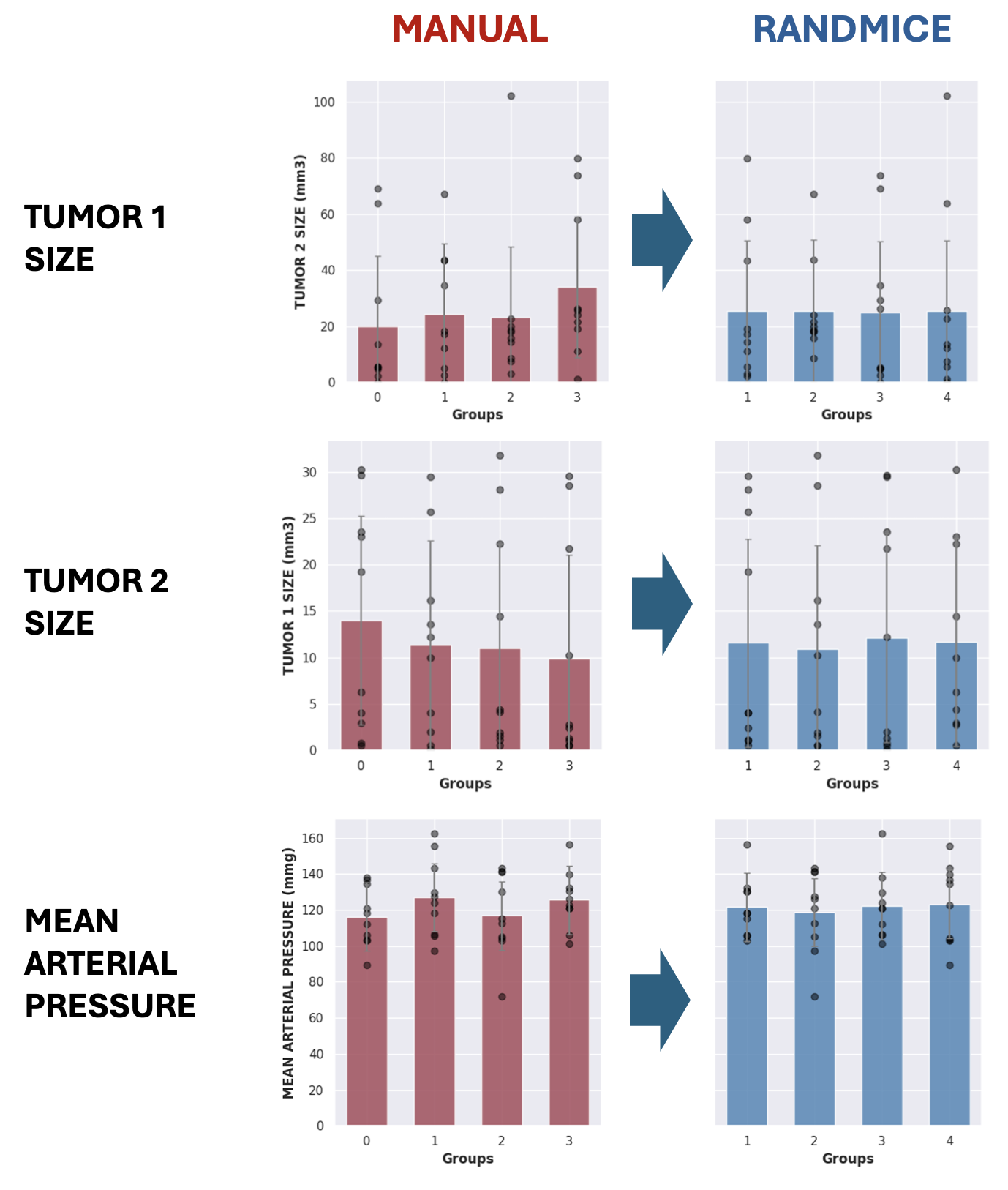
The data presented here demonstrate significantly improved inter-group homogeneity across both tumor volumes and blood pressure when using Randmice's optimized balancing, compared to pure randomization. This enhanced homogeneity is crucial for minimizing variability and increasing the statistical power of your preclinical studies.